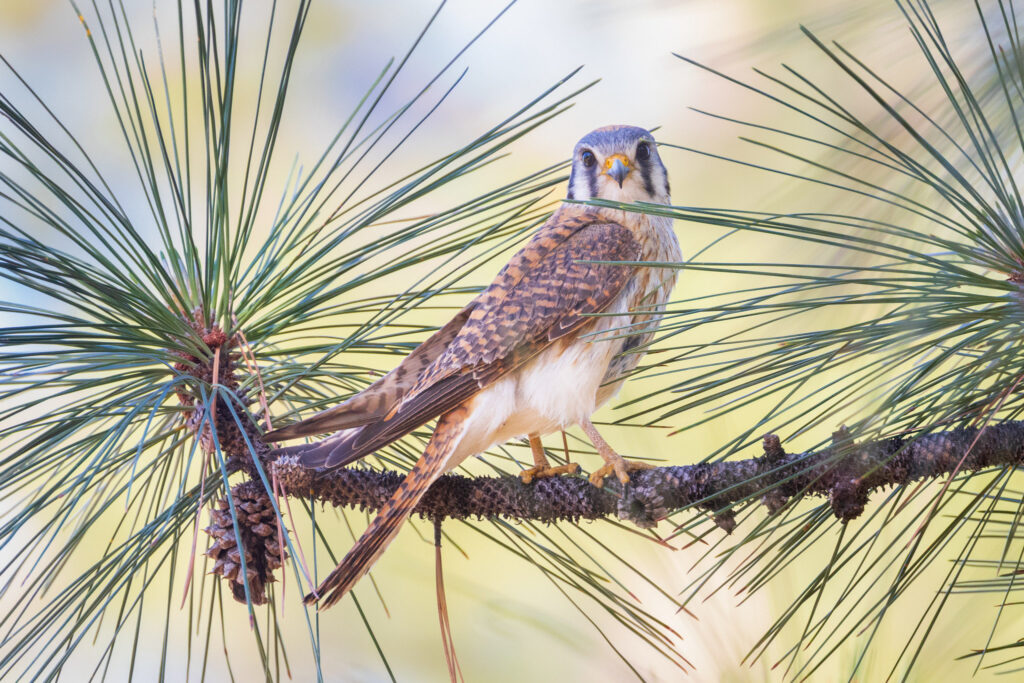
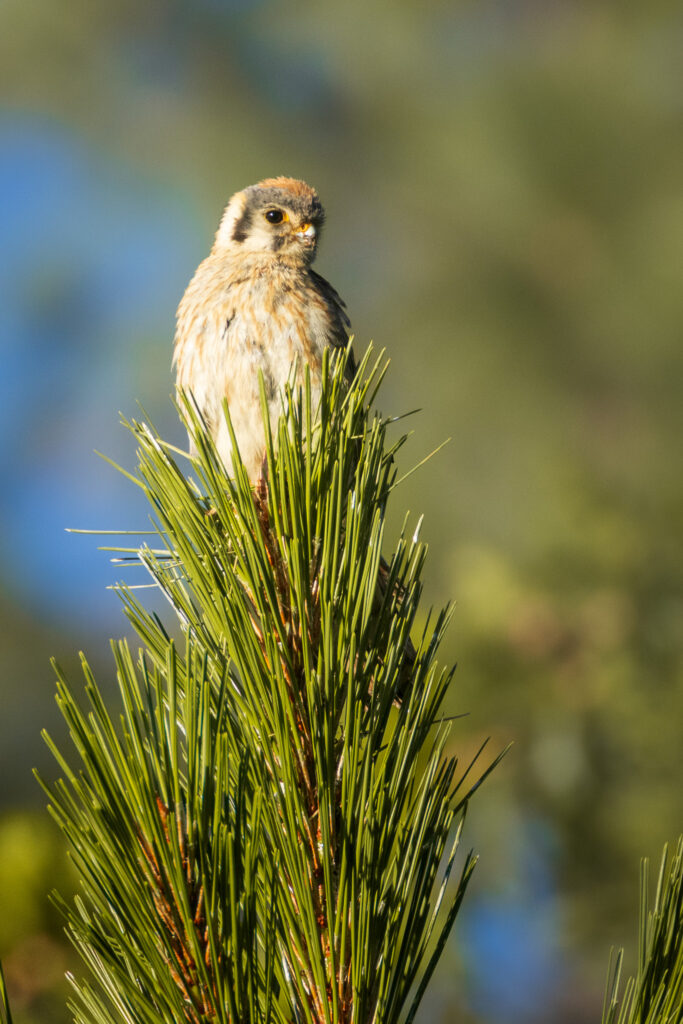
This may be a bit redundant for folks following me on Facebook, but I thought I’d use this format to do a long-form post about one of the most fun and interesting things I’ve ever done without leaving home. Please note many of the stills I’ll post here are single frames from vids and/or were captured in less than stellar light, so bear with me on image quality.
I’ve lived at the same address in Janesville California since 2001. Our property is situated right on the eastern edge of mixed oak and coniferous forest, right on the “seam” where the woods give way to high desert at 4000 feet above sea level. This location is wonderful for a large diversity of wildlife right in our yard throughout the year (I lost count on bird species that have visited well north of 50). One bird that I’ve seen over the years has been the American kestrel. I’ve spotted them alone and in pairs flying by and perched in trees on the property. I’ve also known for quite some time that the kestrel is a cavity-nesting bird that will utilize a properly sized and situated birdhouse. I also just happen to be a reasonably decent woodworker. Therefore, for a number of years I always THOUGHT about building a kestrel birdhouse. In the 2024–2025 winter I finally stopped just talking about it and put a couple together. It just so happened that I had some slabs of California black oak that I cut out of a large tree that blew over on the property some years back, and I figured using some of that rough and rustic material would just add an additional “cool factor.” The preferred location for these nest boxes, according to my reading, is between 10–30 feet off the ground and preferably at the edge of a more open area such as a field or meadow. This pine adjacent to a fairly open area on our 2-acre parcel seemed to fit the bill (and is in a location where I can see it clearly while not too close to a high human-traffic area on the property). Therefore, I hung the house we’ll discuss here about 15 feet up in the tree — about as high as I felt safe scaling a ladder with a birdhouse and drill/driver.
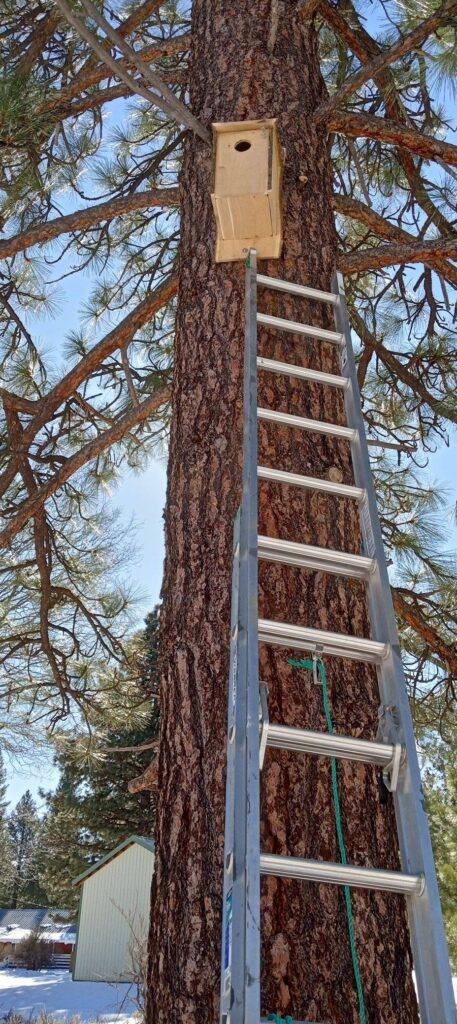
Once it was hung — this past February if I recall — it was just a matter of waiting to see what would happen.
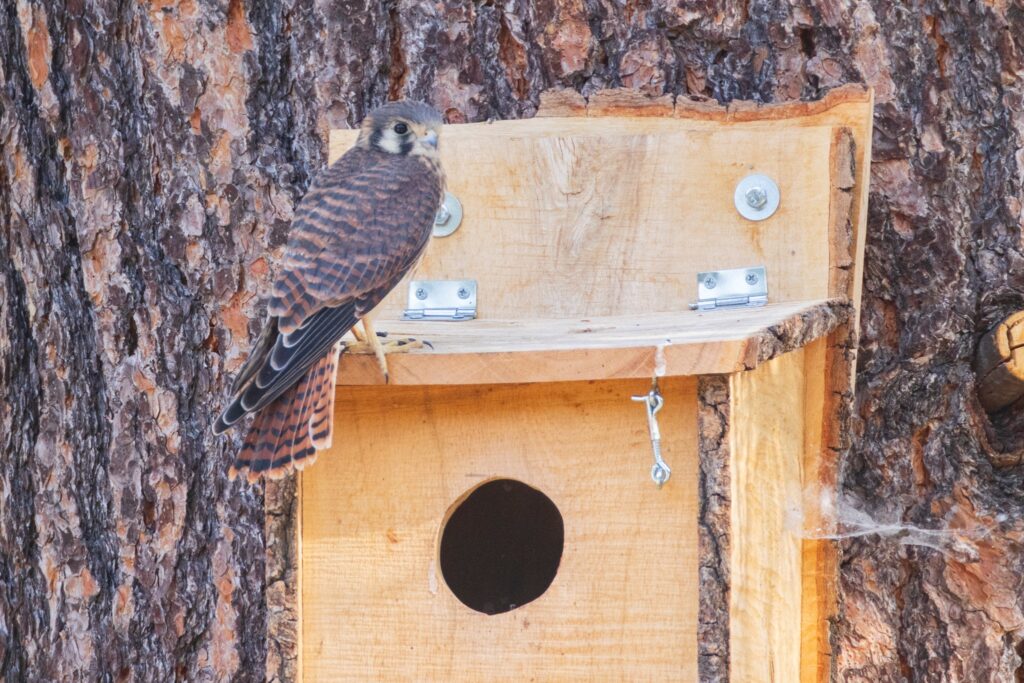
I glanced that way on April 12th and saw someone hanging out on, and going in and out of, the house. I grabbed my camera and telephoto and took a look, and was immediately excited to see a potential tenant.
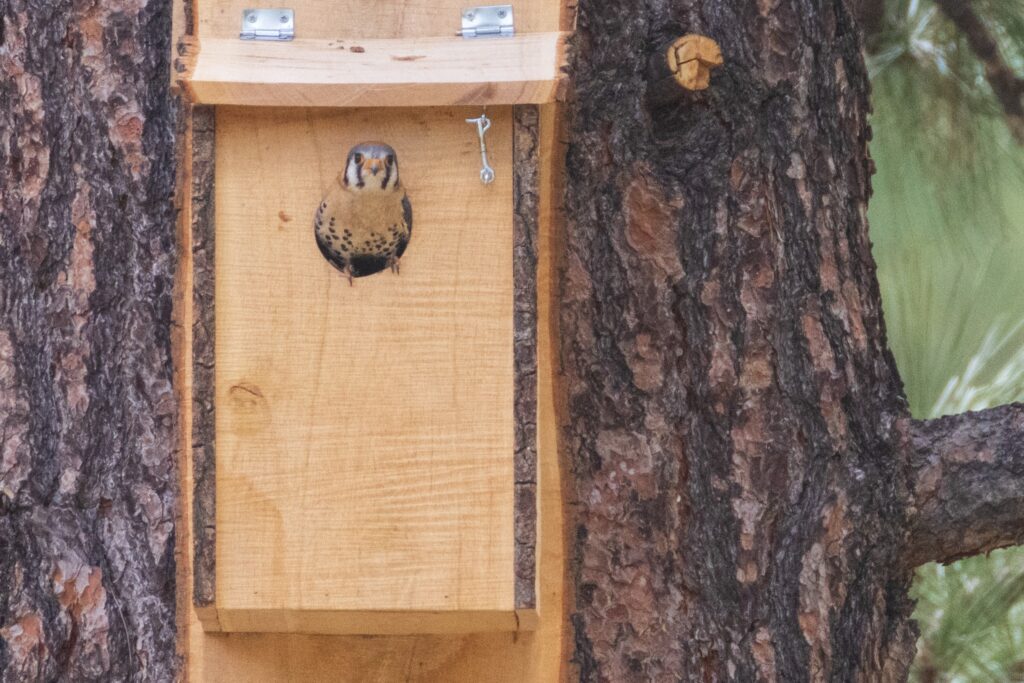
A couple days later, I was even more excited to see a Mr. AND a Mrs. at the same time.
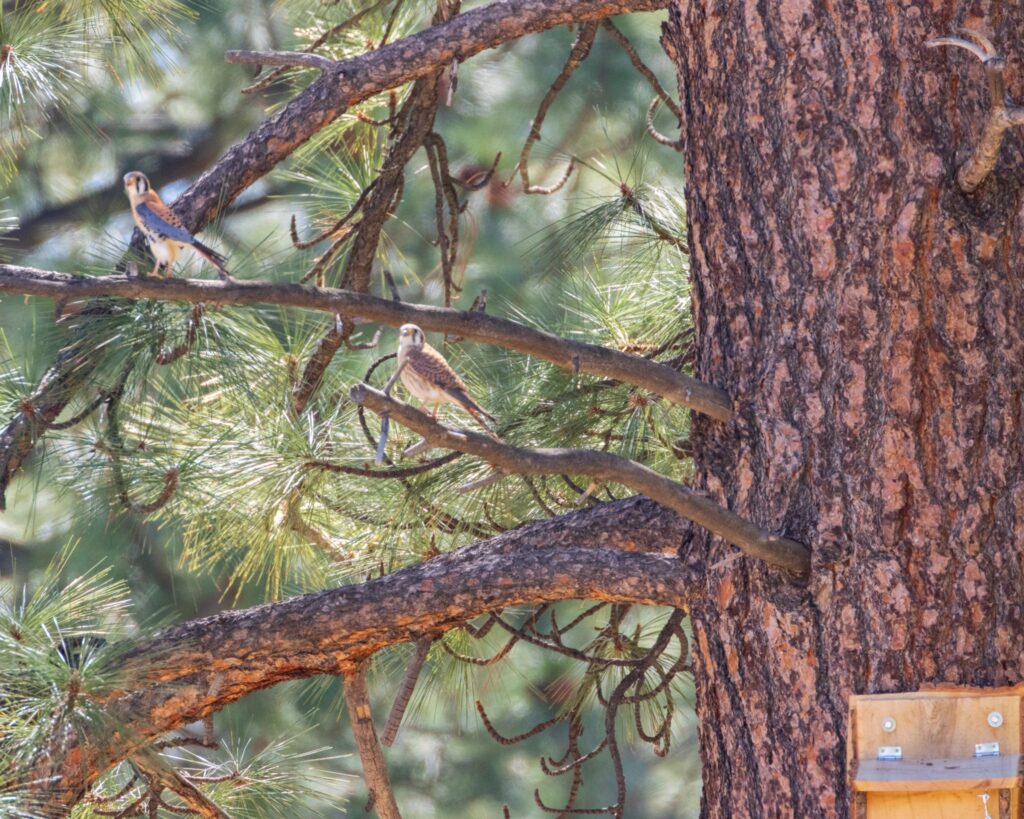
After a few more sightings of the male OR the female, there was about a 6-week period where I only saw the female and not the male. I began to wonder if maybe the pairing didn’t happen when, on June 15th, I began to see the female bringing some protein to the nest.
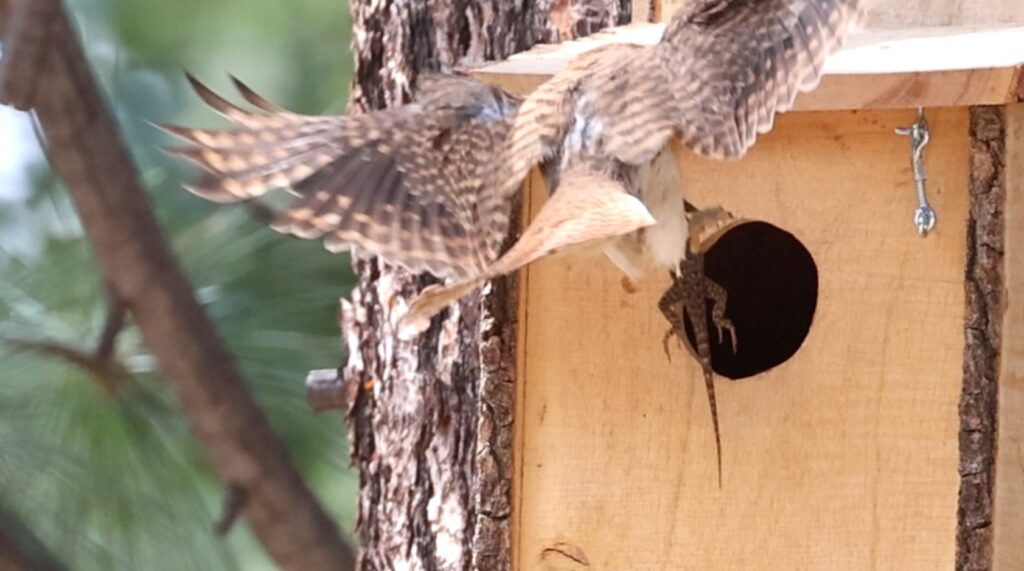
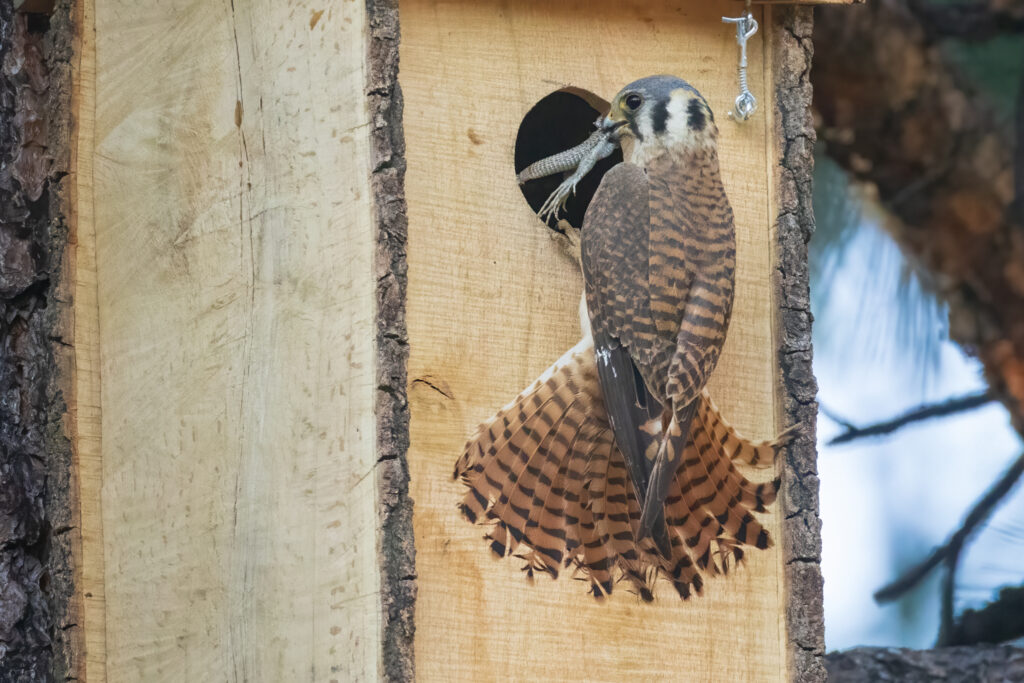
I still didn’t see the male for a time, but my research indicates that kestrels won’t usually bring food back to the nest site to feed themselves, so I figured they must have chicks in there!
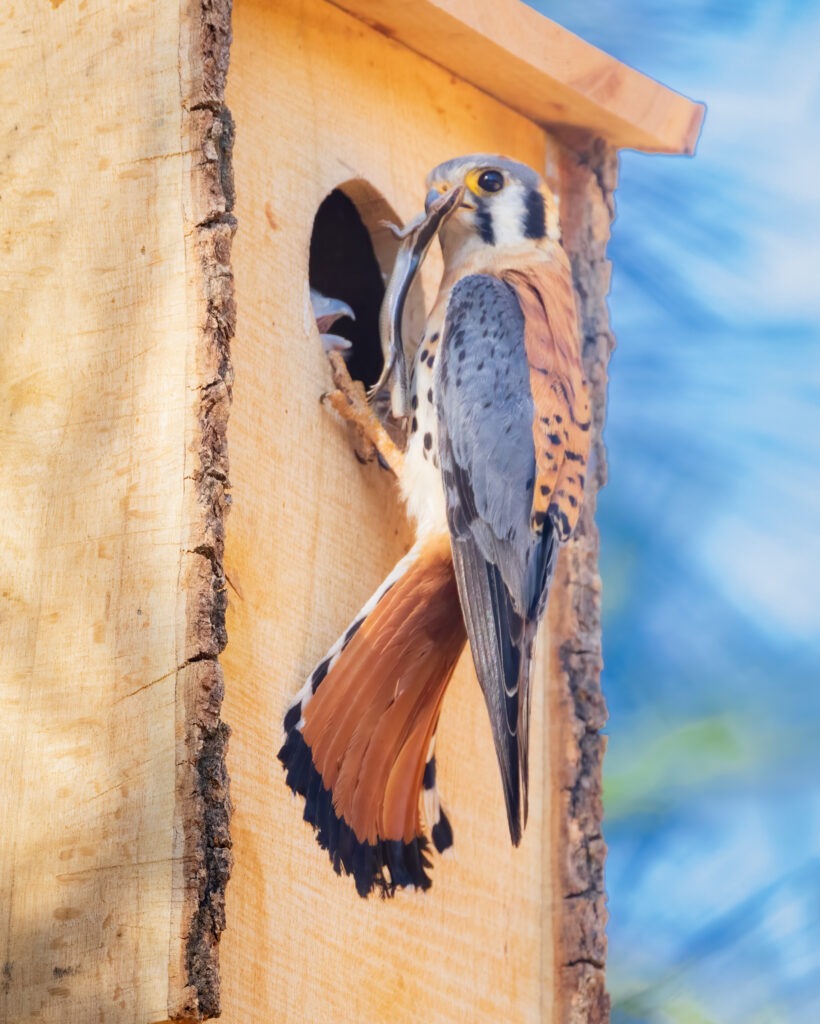
Over the course of the next several weeks I started seeing the male again and watched both parents coming and going bringing food into the box, and finally started hearing definite peeps coming from the box when mom and dad were out hunting. I never did figure out exactly how many they had, but it was at least 3 or 4, possibly more (clutches of 5 and 6 are not uncommon). The primary diet mom and dad brought the babies was reptilian in the form of western fence lizards and blue-tailed skinks, but they also brought a number of larger insects and at least one small rodent (perhaps a vole or mole) that I caught. As time went on, the little ones got VERY loud when one of the parents came back to the nest with a morsel, and I started to see just hints of little heads popping up in those very brief moments (the handoffs can be LIGHTNING fast). Finally, on July 8, as I hid in a little hide that I built so I could activate my camera remotely as it was positioned near the nest (more on that shortly), I captured this moment as dad brought a skink home…
Around about that same time I started frequently capturing youngsters hanging out in the door of the house, vocalizing and anxiously waiting for mom or dad to feed them as they grew and developed all their feathers very quickly. Somewhere on the 12th or 13th of July the little ones fledged and I no longer heard any voices coming from the house or saw mom and dad bringing food. For the next couple weeks though, the youngsters stayed in the area and I could frequently hear them in the nest tree or another nearby pine they seemed to like. As noted before, it was definitely SEVERAL voices but I never got a sufficient look at them all to know the exact clutch size. I DID occasionally see one drop back by the house for a quick stop.
Throughout the course of this process the adults got noticeably more comfortable with me being in the vicinity of the nest. That said, I made a conscious effort to give them their space and minimize the time I spent close to the nest setting up camera gear, etc. One way I did this was to make a makeshift camera mount atop a tall step ladder. In this way I was able to shoot video clips by attaching an intervalometer to the camera, set to activate the shutter button every 2 minutes. This made my camera shoot half the time — 2 minutes on, 2 minutes off — until a card was full, about 2 hours or so. It was a bit tedious to go through all that video (if I’m honest I STILL have some I have yet to go through), but I felt this was the least intrusive way to get some shots of them doing their thing undisturbed. I also have a small “hut” that I previously built as a backyard bird-photo hide, which I set up nearby where I could see the birds coming and going and activate the camera remotely for stills. I’ll put together a short video consisting of some of the clips I got below — I shot some in “high frame rate” mode, which renders decent slow-motion captures (best for trying to actually see a lizard or rodent being delivered, but sans audio), and others in real time with a decent mic attached to capture some of the vocalizations. Some of the video clips are below:
Of course, on a couple of occasions I did try to get out there and get some shots in nice light with the camera actually in my hand. The female was the most cooperative…