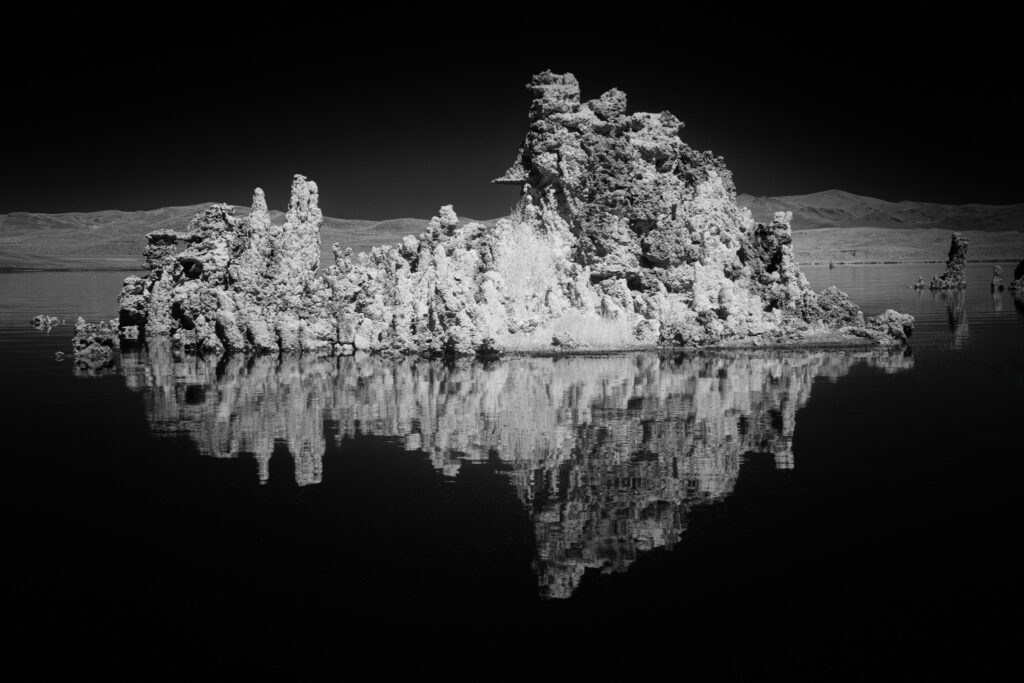
I captured this frame with my 830-nanometer deep infrared filter on my full-spectrum camera while on a brief mid-day stop at Mono Lake in California. I like the dramatic black and whites that can be created at this wavelength, which is completely outside the visible part of the spectrum that ends somewhere around 700 nanometers. The dramatic black and white makes me think of the great Ansel Adams’ work. It sort of depends on whose article you read about him as to whether he liked IR or not. I watched a seminar given by a lady who studied under him and said he loved shooting IR film. However, I’ve also read a few pieces saying that he preferred traditional black and white film and just a red filter (sort of the same effect but milder) when he wanted a punchy, high-contrast look. In any event, I think of him pretty much any time I shoot nature sans color.
Tufa towers like the one shown here consist of limestone that forms when underground carbonate-rich springs, often referred to as soda springs, flow into lakes or streams and precipitate out their minerals. Mono Lake is one of the more famous locations for these striking formations as it has many of them, and some are quite large..
Prints available here.